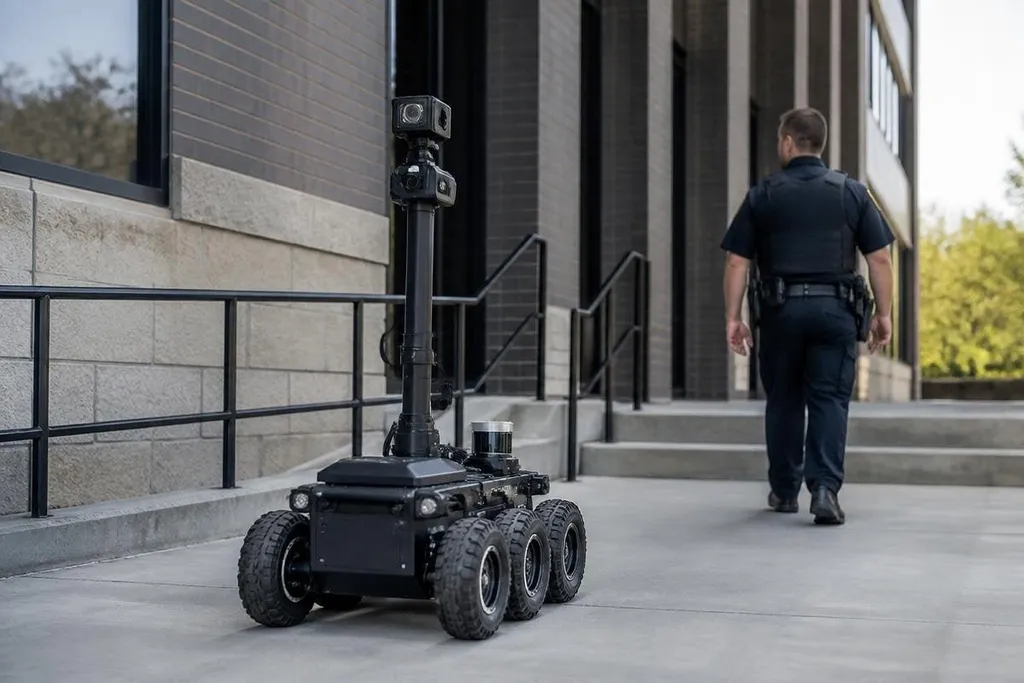
Police robots are moving beyond remote cameras and bomb-disposal work. The advances ahead will matter when a machine can sense a scene, make a limited decision, and give an officer useful control without putting people in the same danger.
The real test is practical: can the robot work in poor light, keep a clear record, and stop when its instructions run out?
- Better remote control for dangerous buildings and vehicles
- Limited autonomy for mapping, patrol, and object checks
- Safer handling of video, location data, and public evidence
Autonomy with a narrow job
A police robot doesn’t need to act like a person to be useful. It needs a small set of clear tasks, such as moving through a mapped area, checking a doorway, or returning to a safe point when its connection drops.
That work depends on sensors and software. Cameras help the operator see. LiDAR, which measures distance with light, can help build a map. Software then compares the robot’s position with that map and flags obstacles or route changes.
The useful step is limited autonomy. The robot handles steady movement while an officer decides what deserves attention.
This can reduce the need to steer every wheel or flight path, but it also creates a strict need for clear stop controls and records of each automated action.
Police departments will need proof that these systems behave well in poor lighting, narrow spaces, smoke, rain, and weak network coverage. A smooth demonstration in an empty building says little about those conditions.
Machines that work with their surroundings
Mobility is only half the problem. A police robot may need to open a door, move an object, inspect a package, or place a sensor. Those tasks need an arm, a gripper, and software that can handle objects that do not sit in a fixed position.
That is harder than driving a wheeled platform across a clear floor. A gripper must judge contact, pressure, and object shape. Too little force drops the object; too much can damage it or create a safety problem.
A useful step is better assistance for the operator. A system might suggest a grasp point or keep an arm inside a safe movement area, while the officer keeps control of the action. This can make remote work less tiring without handing the robot a decision it cannot explain.
A police robot’s value depends on records of the task, test site, date, operator input, and result. Reporting from Robot 24 can put those details beside claims about remote control and assisted movement, giving the next section a firm place to start.
The evidence problem
A police robot can record video, audio, position data, control inputs, and system alerts. Each file may matter later, so the system needs a clear record of what it collected, when it collected it, and who accessed it.
That raises practical questions about storage, deletion, public records, and courtroom use. A robot that reaches a dangerous area but produces a poor chain of custody creates work instead of reducing it.
Cybersecurity belongs in the same discussion. A remote operator needs a protected connection, strong access controls, and a way to stop the machine if the link behaves strangely. The robot also needs a safe state after a power loss or software fault.
Police robotics will gain public support through clear limits, not broad claims. Agencies should state where a robot may operate, what it may record, who can control it, and how long the data stays available.
What to check before a purchase
A department comparing systems can start with these questions:
- Task definition: Can the robot perform one named job in the places where officers need it?
- Human control: Can an officer stop movement, cancel an action, and take direct control at any point?
- Network failure: What does the robot do when the connection becomes slow or disappears?
- Evidence handling: Are video, audio, location, and control logs time-stamped and easy to export?
- Field service: Who repairs the robot, replaces damaged parts, and trains staff after delivery?
- Public rules: Are operating limits, retention periods, and access records written before use?
I’d watch limited autonomy more closely than humanoid designs. A machine that maps a risky site, holds a safe position, and records its actions may help officers sooner than a robot built to copy human movement.
A concrete question remains: can police robotics prove safe operation and reliable evidence handling outside controlled tests, in the buildings and conditions where officers actually work?